
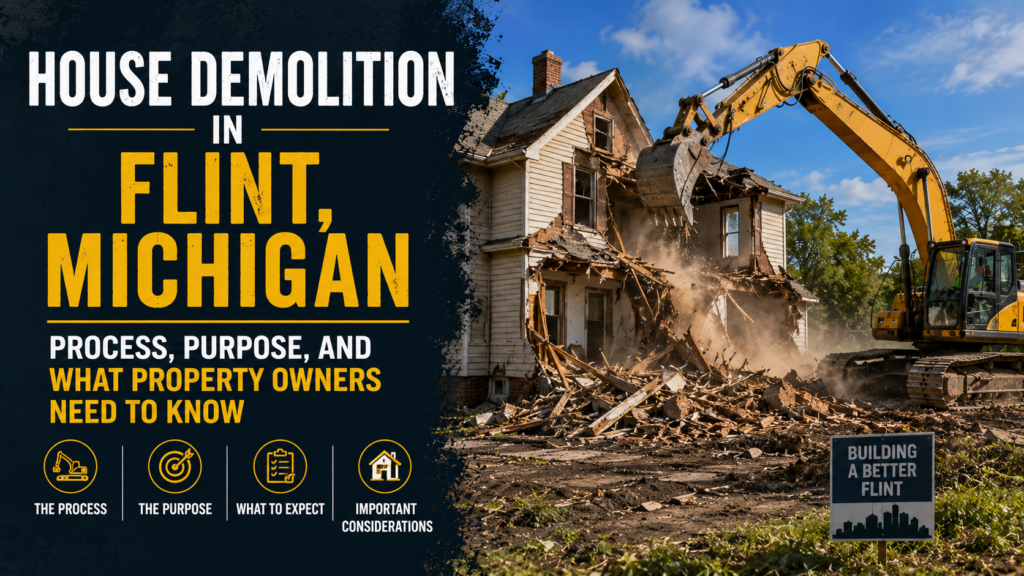
House demolition is a skilled trade that sits at the intersection of engineering, safety management, environmental compliance, and community revitalization. In Flint, Michigan, it has taken on particular significance over recent years as the city works to address a substantial inventory of vacant, abandoned, and structurally compromised residential properties. Understanding what House Demolition Flint involves and why it matters for Flint’s neighborhoods is important for property owners, community stakeholders, and anyone considering demolition as a solution to a deteriorating structure on their land.
When Is House Demolition the Right Choice?
There are several circumstances in which demolishing a home is the most practical or necessary course of action. A structure that has suffered extensive fire damage may be unsafe to occupy or repair, with compromised load-bearing elements, weakened foundations, and materials too far gone to restore at reasonable expense. Similarly, homes that have experienced severe water damage from flooding, chronic roof leaks, or burst pipes may have structural decay that makes rehabilitation economically unfeasible.
Properties that have been vacant for long periods often deteriorate to a point where they become a safety hazard to neighboring residents. Large cracks in exterior walls, sagging rooflines, collapsing porches, and deteriorating foundations are all signs that a structure may be past the point of safe habitation or reasonable repair. In these cases, demolition protects the surrounding community and allows the land to be reclaimed for productive use.
Some property owners choose demolition proactively as part of a development plan. If an older home sits on a lot where new construction is planned a larger custom home, a commercial building, or a multi-unit residential development demolishing the existing structure is the first step in making room for something new. Modern homes built on cleared lots are generally more energy-efficient and can be designed to meet current safety and accessibility standards that an older structure may not satisfy.
Flint’s Blight Elimination Efforts
Flint’s relationship with house demolition is shaped significantly by the city’s experience with population loss, economic decline, and the resulting wave of abandoned properties. Since the Genesee County Land Bank Authority was established in 2004, it has demolished more than 8,400 blighted structures across Flint and Genesee County. These demolitions have been funded through a combination of local, state, and federal sources, including grants from the U.S. Department of Housing and Urban Development and allocations from the American Rescue Plan Act.
The Genesee County Land Bank has secured approximately fifty-seven million dollars from various sources to continue blight elimination work through 2026. The city’s own Neighborhood Stabilization and Beautification Program has also pursued large-scale demolition initiatives, with more than two thousand demolitions planned across Flint neighborhoods. City officials have described these efforts not merely as the removal of unsafe structures but as a means of restoring safety, dignity, and hope to communities that have lived alongside deteriorating vacant properties for years.
The House Demolition Process
A professional house demolition in Flint follows a structured sequence designed to ensure safety, regulatory compliance, and efficient site clearance. The process begins well before any machinery arrives on site.
Permits are required before any residential demolition work can begin. Property owners must submit an application to the appropriate city or county building department, and the work must be reviewed for compliance with the Michigan Residential Code. Any contractor performing demolition work with a contract value of six hundred dollars or more must be licensed under Michigan’s Residential Builder Laws.
Before demolition begins, all utilities must be disconnected. This includes electricity, natural gas, water, and sewer connections. Utility companies are notified in advance, and formal disconnection must be confirmed before structural work starts. This step is non-negotiable; attempting to demolish a building with live utilities still connected creates serious risks of fire, explosion, electrocution, and flooding.
A hazardous materials inspection may also be required, particularly for homes built before the 1980s. Older residential structures in Flint frequently contain asbestos in insulation, floor tiles, and pipe wrap, as well as lead-based paint. These materials must be identified and, if present, abated by certified specialists before the main demolition can proceed. Proper abatement protects workers, neighboring residents, and the environment from dangerous exposures.
Once permits are obtained, utilities disconnected, and any hazmat abatement completed, the physical demolition can begin. Depending on the size of the structure and site conditions, demolition may be accomplished using excavators, bulldozers, or a combination of mechanical equipment and hand tools. Contractors are required to notify neighbors with door hangers at least one week before demolition begins, allowing them to take precautions against dust and vibration.
After the structure is knocked down, debris is loaded out and hauled to appropriate disposal or recycling facilities. Concrete, steel, and certain other materials may be recycled rather than landfilled, supporting environmentally responsible practices. Once the site is cleared, it is graded to a clean, level surface for future use.
Structural vs. Interior Demolition
Not all demolition projects involve the complete teardown of a structure. Interior or selective demolition refers to the targeted removal of specific elements within a building walls, flooring, ceilings, fixtures, or mechanical systems while the exterior shell and structural components remain intact. This type of work is common during major renovations, building repurposing projects, or when only part of a structure needs to be removed to accommodate changes.
Full structural demolition, by contrast, brings the entire building down to grade. The approach used depends on the project goals, the structural condition of the building, and whether any materials are to be salvaged before demolition proceeds. Salvage operations removing doors, windows, fixtures, lumber, or other reusable components before demolition can reduce waste, offset costs, and preserve materials that might otherwise be lost.
Site Safety During Demolition
House demolition is inherently a high-risk activity that demands strict safety protocols. Crews must work methodically to avoid unexpected structural collapses, manage dust and debris, protect underground utilities near the structure, and ensure that neighboring properties are not damaged in the process. Professional demolition contractors maintain detailed safety plans, use personal protective equipment, and conduct their work in compliance with OSHA regulations and local ordinances.
In Flint, contractors working on blighted properties face additional challenges related to the condition of the structures themselves. Buildings that have been vacant for years may have weakened floors, deteriorating load-bearing walls, compromised roof structures, and other conditions that require careful assessment before heavy machinery is deployed. Experienced demolition professionals conduct thorough evaluations before work begins to identify and account for these hazards.
The Role of Demolition in Community Revitalization
While demolition might seem like an endpoint, in Flint it is often a beginning. Removing a blighted structure clears the way for new investment, whether that takes the form of new residential construction, community green spaces, urban agriculture, or commercial development. Mayor Sheldon Neeley has described the city’s demolition program as a key part of transforming Flint block by block, recognizing that visible blight deters investment and erodes confidence in neighborhoods that are otherwise primed for renewal.
For individual property owners, house demolition opens up options that a deteriorating structure forecloses. A cleared lot can be sold, developed, or donated to a community land trust. The removal of a liability a collapsing structure that attracts vandalism, harbors pests, and creates safety risks is itself a form of improvement that benefits the immediate surroundings as well as the owner.
Conclusion
House demolition in Flint is a multi-step process governed by permits, safety regulations, and environmental requirements. It is also a meaningful contribution to the city’s ongoing revitalization, helping to reclaim land from blight and restore the safety and dignity of neighborhoods that have experienced long periods of disinvestment. For property owners navigating the decision to demolish, understanding the process and working with licensed, experienced demolition contractors is the surest path to a safe, compliant, and successful outcome