
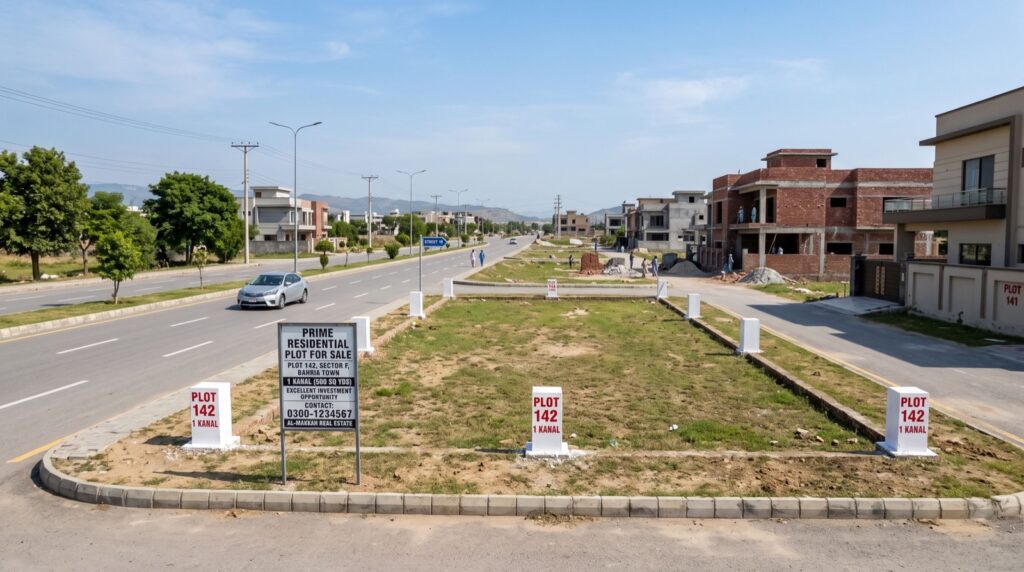
There is a persistent myth in Pakistani property circles that serious real estate investing starts at fifty lakh rupees and anything below that is just saving with extra steps. The twin cities’ market tells a different story. Some of the best percentage returns of the past decade were earned not in the prestige sectors of Islamabad but in emerging corridors on the city’s edges, by investors who entered early with modest capital, chose the right category of plot, and understood when to hold and when to rotate.
What separates those investors from the crowd is not inside information — it is category selection. Residential plots, commercial plots, and built property behave like three different asset classes, each with its own entry price, risk curve, and exit dynamics. This article walks a small-capital investor through those differences, explains why emerging corridors around Rawalpindi have become the natural hunting ground, and sets out a sequence for building a portfolio one deliberate step at a time.
Residential and Commercial Are Different Games
A residential plot is a patience instrument. Its value climbs with development milestones — roads, utilities, occupancy — and its eventual buyer is a family or a builder. Demand is broad and steady, downturns are shallow, and liquidity is the best in the market. The trade-off is that spectacular short-term jumps are rare; residential wealth compounds rather than explodes.
A commercial plot is a leverage-on-footfall instrument. Its value depends on how many people will eventually pass, park, and spend in front of it, which makes it far more sensitive to a society’s success. When a project fills with residents, its commercial strips can re-rate to multiples of their launch price — appreciation residential rarely matches. But if occupancy disappoints, commercial corrects harder and sits longer without buyers. Higher ceiling, lower floor: that asymmetry defines the choice.
Why Emerging Corridors Beat Established Sectors for Small Capital
In Islamabad’s developed sectors, the growth story has already been priced in; entering costs crores and future upside is largely rental yield. The mathematics for small capital only works where land is still cheap relative to its trajectory — along the ring road alignments, airport-linked corridors, and motorway interchanges around Rawalpindi, where new master-planned communities are converting farmland into serviced urban blocks.
The vehicle for this entry is the private development sector. Well-run Affordable Private Housing Societies rawalpindi buyers now have access to offer approved layouts, installment-based entry, and development pace that public-sector schemes rarely match — which is exactly what a small investor needs: a low ticket into a corridor whose infrastructure story is still being written. The skill lies in filtering for genuine approvals and actual development, because the same corridor that hosts the decade’s best performers also hosts its paper schemes.
The Rental Yield Question Nobody Asks Early Enough
Plots produce no income; they cost money to hold — transfer fees in, transfer fees out, and possibly development charges in between. That is acceptable during the high-growth phase of a corridor, but every investor should know in advance what the asset converts into once appreciation normalizes. Residential plots convert into houses yielding modest single-digit rents. Commercial plots convert into shops and offices that, in a populated society, can yield roughly double the residential rate and attract longer-term business tenants.
This is why seasoned investors treat commercial as the destination even when residential is the entry: the endgame asset is a rent-producing commercial unit in a community that has already proven its footfall. Planning that conversion from day one — rather than discovering it in year six — changes which plots you buy today.
Sizing Your Entry Without Overreaching
The most common small-investor error is buying the largest file an installment plan will technically allow. A better discipline is to size the commitment so that all property payments stay within what your income could sustain through a twelve-month rough patch, and to keep a reserve for the charges that surround a file: transfer costs, possession dues, and location premiums. An investor forced to sell mid-schedule almost always sells at a discount; staying power is the small investor’s only real edge over the market’s big players.
For those ready to step up from residential files, category research matters more than ever. Studying what Commercial Plots in Islamabad corridor projects actually cost, in which sizes, and on what schedules gives you a concrete benchmark for the premium commercial commands over residential in the same development — and whether your capital plus buffer genuinely covers that premium, or whether another year of accumulation comes first.
Timing Purchases Inside a Society’s Life Cycle
Every successful development passes through phases, and each phase prices risk differently. Pre-launch and launch offer the lowest rates and the highest uncertainty. The development phase — machinery on the ground, first possessions announced — trims some upside but removes the existential risk. The occupancy phase, when families move in and shops open, is when commercial re-rates fastest. Buying residential at launch and commercial at early occupancy is a sequence many corridor investors have used to let the society de-risk itself between their two entries.
Whatever the phase, insist on the same evidence: sanctioned layout covering your block, written payment schedules, and a resale market where real transactions — not just quoted rates — are happening.
Exits: Decide the Sell Rules Before You Buy
An investment without an exit rule is a hope. Before booking, write down the conditions under which you will sell: a target multiple, a development milestone, or a time horizon. Corridor plays reward holding through the noisy middle years, but they punish both panic-selling on rumor and the opposite failure — riding a mature plot for years after its growth has flattened when the capital could be rotated into the next early-phase corridor.
Execution details decide realized returns: transfer timing relative to announced milestones, dealer selection, and documentation hygiene. Small investors who work with reliable local experts on transfers and file verification consistently capture more of their paper gains than those improvising each step, simply because errors at the transfer office are expensive precisely when prices are moving.
Key Takeaways
- Residential plots compound steadily with broad demand; commercial plots offer a higher ceiling tied to occupancy and footfall, with a harder floor.
- Small capital works best in emerging Rawalpindi corridors where infrastructure growth is still unpriced, accessed through approved private societies.
- Know what your plot converts into: commercial units in populated societies roughly double residential rental yields.
- Size entries to survive a twelve-month income shock; forced mid-schedule sales surrender the small investor’s only edge.
- Sequence purchases with the society’s life cycle and write your exit rules before you book, not after.
Conclusion
Small-capital property investing around the twin cities is neither the lottery its promoters advertise nor the trap its cynics describe. It is a craft with learnable rules: pick the category that matches your horizon, enter corridors before their infrastructure story is fully priced, size positions for staying power, and treat commercial plots as the yield engine your portfolio eventually graduates into.
None of these rules require wealth to apply — only discipline and a willingness to verify before paying. The investors who built real portfolios from one modest file all started with that discipline, letting each completed schedule fund a slightly stronger position in the next. The corridor keeps producing opportunities; the question is simply whether you approach the next one with a plan or a hunch.