
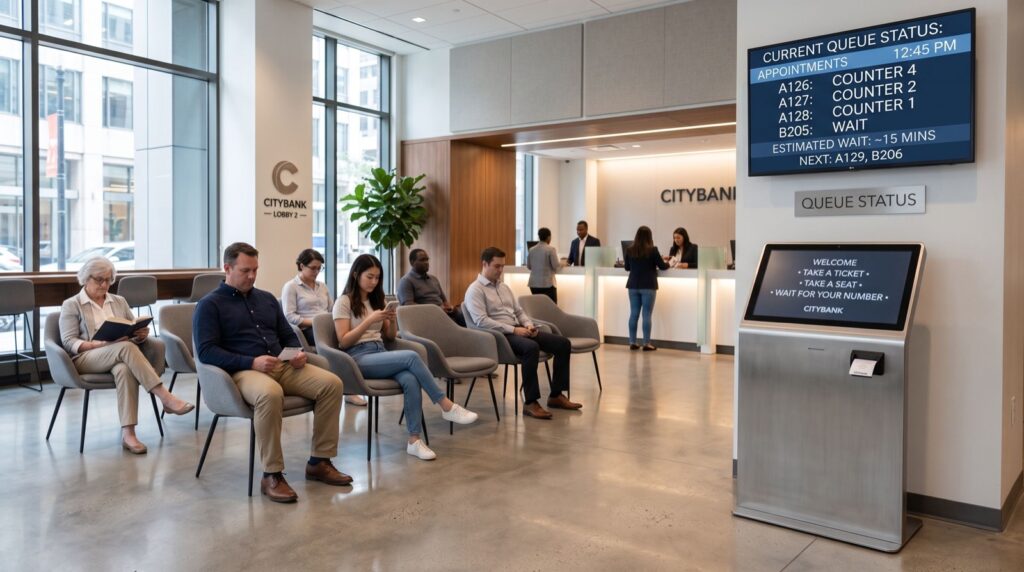
Every service manager in the Kingdom knows the feeling of watching a lobby fill up faster than the counters can cope. Frustrated customers, stressed staff, and no clear picture of what is actually going wrong. Deploying a proper queue management system in saudi arabia is the fix that turns that daily scramble into a predictable, data-driven operation, and in 2026 it has moved from a nice-to-have to a baseline expectation.
Rather than repeat generic sales copy, this article looks at queuing through the lens of throughput, the number of customers a branch can serve well per hour. We will explore the metrics that matter, real deployment scenarios across banking and quick-service settings, and how counter-facing technology like drive-thru systems ties into the same experience goals. By the end you will know what to measure and what to buy.
Rethinking the queue management system in saudi arabia around throughput
Most buyers focus on the visible parts: the ticket machine and the display screen. Those matter, but throughput is the metric that actually protects revenue and reputation. Throughput is a function of three levers: how quickly a customer is routed to the right counter, how long each service interaction takes, and how well staffing matches demand.
A digital queuing platform improves all three. Intelligent routing sends the customer to the correct agent the first time. Service timers reveal which transactions drag. And live dashboards let supervisors open more counters before a backlog forms rather than after.
The metrics worth tracking
- Average wait time: the headline number customers feel most.
- Average service time: how long each interaction takes at the counter.
- Abandonment rate: how many people leave before being served.
- Peak-hour load: when demand spikes, so staffing can flex.
- First-contact resolution: whether the routing sent them to the right place.
Real scenarios where queuing changes the outcome
Abstract benefits mean little without context, so consider three environments common across Saudi cities.
Banking branches
A retail bank in Jeddah splits walk-ins into teller transactions, account opening, and wealth advisory. Before queuing, everyone shared one line and premium clients waited behind routine cash deposits. After deployment, priority routing pulls high-value customers forward, and the branch reports both shorter waits and higher satisfaction among its most profitable segment.
Healthcare service desks
Hospitals juggle registration, billing, and pharmacy pickup. A unified queuing platform links these steps so a patient who finishes registration is automatically queued for the next department, removing the need to grab a fresh ticket each time.
Quick-service and drive-thru
Speed is the entire proposition at a drive-thru lane, and the same order-flow logic that governs an indoor queue applies outdoors. Deploying PAR Drive Thru in Saudi Arabia brings timing displays, order confirmation screens, and sequencing that keep cars moving and orders accurate during rush periods.
How queuing and drive-thru share the same DNA
Indoor queuing and drive-thru sequencing solve the same puzzle from different angles: get the right customer to the right service point in the right order, fast. Both rely on clear signalling, both benefit from timing analytics, and both fail when a bottleneck goes unnoticed.
| Feature | Indoor queue system | Drive-thru system |
|---|---|---|
| Customer signal | Numbered ticket or QR check-in | Menu board and confirmation screen |
| Routing logic | Service-type and priority rules | Lane sequencing and order pacing |
| Core metric | Wait and service time | Cars per hour and order accuracy |
| Analytics goal | Reduce lobby congestion | Cut total lane time |
Viewing them together helps multi-format operators, such as a bank with an in-branch café or a retailer with a pickup lane, standardise their experience strategy instead of buying disconnected tools.
A practical rollout roadmap
Buying the hardware is the easy part. A disciplined rollout is what delivers the throughput gains. Follow this order.
- Baseline your current waits and service times so you can prove improvement later.
- Map every service type and define priority rules before configuring the system.
- Pilot in one high-traffic branch and gather staff feedback for two weeks.
- Adjust routing rules based on real data, not assumptions.
- Scale to remaining sites with a central dashboard rolling everything up.
Engaging reliable local experts for the pilot phase pays dividends, because the routing rules that work in theory often need real-world tuning before a wider launch.
One insight most buyers miss
Do not over-segment your queues at launch. A dozen narrow service categories confuse customers and fragment your staff, which actually lowers throughput. Start with three or four broad categories, watch the data for a month, then split further only where the numbers justify it.
A second lesson comes from staffing. The dashboard will quickly reveal that demand is not flat across the day. Instead of fixed shifts, use the peak-hour data to schedule extra agents in the two or three windows that actually spike. Many Saudi branches discover that a single floating agent, moved to the busiest counter on demand, does more for throughput than adding a permanent desk.
Measuring return on investment
Executives approve budgets when they see numbers, so translate queuing gains into money. Start with the abandonment rate. Every customer who leaves before service is lost revenue or a lost renewal, and cutting that rate even a few points across a busy branch adds up fast across a year.
Then factor in staff efficiency. When routing sends customers to the right counter the first time, agents spend less time redirecting people and more time serving them. That reclaimed capacity often lets a branch handle rising footfall without adding headcount, which is the clearest return of all.
What to demand from your vendor in 2026
Service-experience expectations keep rising, and coverage from bodies like the National Retail Federation shows customers now judge brands on how effortless a visit feels. Hold your vendor to a real standard.
- Full bilingual Arabic and English interfaces with right-to-left support.
- Open APIs so the platform talks to your CRM, ERP, or core banking software.
- Cloud dashboards for multi-branch visibility from one screen.
- Local warranty, spare parts, and responsive on-site support.
Frequently Asked Questions
What is the main benefit of a queue management system in saudi arabia?
The main benefit is higher throughput: serving more customers well per hour by routing them correctly, shortening service time, and matching staffing to real demand, all backed by live data.
Can one platform manage both indoor queues and drive-thru lanes?
Many modern platforms extend the same sequencing and timing logic to drive-thru operations, so operators with both formats can standardise on a single experience strategy and reporting layer.
How quickly will we see results?
Most branches see measurable drops in wait time and abandonment within the first month, especially once routing rules are tuned using the pilot data rather than initial guesses.
Is mobile queuing supported?
Yes. Customers can often join remotely via a QR code and arrive close to their turn, which reduces lobby crowding and improves the perceived experience.
Conclusion
A throughput-focused queue management system in saudi arabia does more than tidy a lobby; it measurably increases how many customers each branch can serve while lifting satisfaction. Pair it with matching drive-thru technology where relevant, roll it out with a data-driven pilot, and hold your vendor to a bilingual, integration-ready standard. Ready to raise your service capacity in 2026? Speak with a specialist and start with a single-branch pilot.